History of the Faculty
Hits: 712
The modern Egyptian fine arts movement owes much of its foundation to two prominen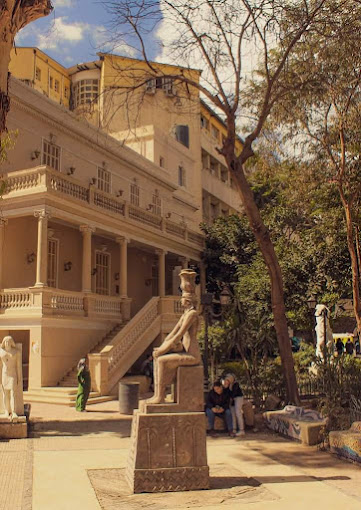 t figures from the aristocracy. The first is Prince Youssef Kamal, who established the first School of Fine Arts in the Middle East on May 12, 1908. He endowed the school with agricultural lands and financial resources, and brought in foreign professors to discover and educate talented individuals from the working class, sending them on scholarships to Europe to further their artistic studies and witness Western civilization in its prime, particularly in Paris.
The second figure is Mohamed Mahmoud Khalil Bey, a member of a wealthy family who dedicated his life and wealth to acquiring artistic masterpieces. In 1923, he established the most significant society for the promotion of fine arts, contributing to the formation of a new generation of visual artists who graduated from the school between 1908 and 1911.
Prince Youssef Kamal dedicated one of his palaces in Darb El-Gamamiz, Cairo, to house the school. He endowed it with 127 feddans of agricultural land and several properties in Alexandria. In his endowment deed, he stipulated that the revenue be used to educate 150 students—two-thirds Egyptian and one-third foreign—regardless of nationality or religion, free of charge. The curriculum included contemporary sciences such as Arabic calligraphy, relief sculpture, design in all forms, art history, and architecture. Teachers were to be appointed from France and Italy. The top two graduates received a bronze medal inscribed with a Quranic verse on one side and “A Souvenir from Prince Youssef Kamal” on the other. In 1927, the Prince amended the terms of the endowment to allocate its revenues for sending art students on scholarships to France and Italy.
In 1910, the School of Fine Arts came under the supervision of the Ministry of Public Education, and the first generation of graduates emerged, becoming pioneers of modern Egyptian art and the enlightenment movement. In 1928, the school was nationalized and renamed the Higher School of Fine Arts. By 1929/1930, the school offered a four-year program across three departments: Architecture, Painting, and Sculpture. In 1931/1932, a Decorative Arts Department was added, with its first graduates receiving diplomas in 1935. A Printmaking Department was added in 1933/1934.
In 1935, the school settled in its permanent location in the Zamalek district after moving through various neighborhoods, including Sayyida Zeinab, Shubra, and Giza Street. In 1950, it became the Royal College of Fine Arts. After the revolution, it was renamed the Faculty of Fine Arts in 1953, and was placed under the Ministry of Higher Education in 1961. It was incorporated into Helwan University in 1975.
The Faculty of Fine Arts is distinguished by the diversity of its academic programs, which span Architecture, Interior Architecture and Scenography, Graphic Arts, Painting, Sculpture, and Art History. These programs are based on research-based learning (RBL), fostering a creative, innovative, and contextually engaged academic environment.
Faculty members are known for their artistic talent, critical insight, and analytical approach, combining artistic practice with teaching, research, and community engagement.
The Faculty adopts a multidisciplinary approach in both teaching and research, encouraging academic partnerships with local, regional, and international institutions.
The Faculty comprises five departments at the undergraduate and postgraduate levels: Architecture, Painting, Sculpture, Decoration, and Graphic Arts, with the undergraduate program structured into five academic levels following the credit hour system. The Department of Art History is exclusively dedicated to postgraduate studies, offering diploma, master’s, and doctoral degrees.